A Meticulous Review Of Martin (2013)
Sunday, 1 October 2023
Seriously Misunderstanding The Sign In Relation To Linguistics And Semiotics
Friday, 29 September 2023
Misunderstanding The Bonding Of Signified And Signifier And The Relation Of Form To Substance
Martin (2013: 5):
… both terms involved in the linguistic sign are psychological and are united in the brain by an associative bond. This point must be emphasised.
Moreover, the terms signified and signifier are mutually defining — the valeur of each is its relation to the other — so each presupposes the other, as Hjelmslev (1961: 48-9) notes for content and expression:
Expression and content are solidary — they necessarily presuppose each other. An expression is expression only by virtue of being an expression of a content, and a content is content only by virtue of being a content of an expression.
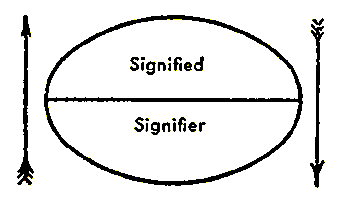
[2] To be clear, the diagram misrepresents Hjelmslev's distinctions in two important ways. First, like the previous diagram, it misrepresents Hjelmslev's (and SFL's) content and expression planes as the strata of lexicogrammar and phonology. Second, it misrepresents content substance (thought) and expression substance (sound chain) as sharing the same domain and level, despite the former being psychological and the latter physical. Hjelmslev (1961: 58):
The sign is a two-sided entity, with a Janus-like perspective in two directions, and with effect in two respects: “outwards” toward the expression-substance and “inwards” toward the content-substance.
Wednesday, 27 September 2023
Misunderstanding The Notion Of A Stratified Semiotic
Monday, 25 September 2023
Seriously Misunderstanding Hjelmslev On Stratification
Martin (2013: 4):
Blogger Comments:
Instead, we shall speak of something whose existence we think we have established, namely the sign function, posited between two entities, an expression and a content. … We have here introduced expression and content as designations of the functives that contract the function in question, the sign function. …
But it appears more appropriate to use the word sign as the name for the unit consisting of content-form and expression-form and established by the solidarity that we have called the sign function.
The distinction between expression and content and their interaction in the sign function is basic to the structure of any language. Any sign, any system of signs, any system of figurae ordered to the purpose of signs, any language, contains in itself an expression-form and a content-form.
In short, Martin has confused Hjemslev's distinction between content and expression with Halliday's view of language as the only semiotic system with a stratified content plane of semantics and lexicogrammar.
Saturday, 23 September 2023
Seriously Misunderstanding Hjelmslev On The Meaning Of 'Sign'
Martin (2013: 4):
Blogger Comments:
This is misleading because it seriously misunderstands Hjelmslev. The quote provided by Martin is part of an argument against the traditional view of the sign, where a sign is a sign for something outside itself: content-substance and expression substance. Hjelmslev (1961: 57-8)
If we now return to the question from which we began, concerning the most appropriate meaning of the word sign, we are in a position to see more clearly behind the controversy between the traditional and the modern linguistic points of view. It seems to be true that a sign is a sign for something, and that this something in a certain sense lies outside the sign itself. Thus the word ring is a sign for that definite thing on my finger, and that thing does not, in a certain (traditional) sense, enter into the sign itself. But that thing on my finger is an entity of content-substance, which, through the sign, is ordered to a content-form and is arranged under it together with various other entities of content-substance (e.g., the sound that comes from my telephone). That a sign is a sign for something means that the content-form of a sign can subsume that something as content-substance.Just as we felt before a need to use the word purport, not simply of the content, but also of the expression, so here again, in the interest of clarity, despite the time-honoured concepts whose shortcomings now become increasingly evident, we feel a desire to invert the sign-orientation: actually we should be able to say with precisely the same right that a sign is a sign for an expression-substance. The sound sequence [riᶇ] itself, as a unique phenomenon, pronounced hic et nunc, is an entity of expression-substance …
The sign is, then — paradoxical as it may seem — a sign for a content-substance and a sign for an expression-substance. It is in this sense that the sign can be said to be a sign for something. On the other hand, we see no justification for calling the sign a sign merely for the content-substance, or (what nobody has thought of, to be sure) merely for the expression-substance.
Hjelmslev (1961: 58) then supports Saussure's use of the word sign, interpreting signified and signifier as content form and expression form, respectively:
But it appears more appropriate to use the word sign as the name for the unit consisting of content-form and expression-form and established by the solidarity that we have called the sign function.
and argues (ibid.) that the traditional view of the sign gives rise to the view that Saussure argued against:
If sign is used as the name for the expression [signifier] alone or for a part of it, the terminology, even if protected by formal definitions, will run the risk of consciously or unconsciously giving rise to or favouring the widespread misconception according to which a language is simply a nomenclature or a stock of labels intended to be fastened on pre-existent things. The word sign will always, by reason of its nature, be joined to the idea of a designatum; the word sign must therefore be used appropriately in such a way that the relation between sign and designatum will appear as clearly as possible and not be subjected to distorting simplification.
In summary, Martin has not only misunderstood Hjelmslev to mean the opposite of what he wrote, but also supported the view that Saussure explicitly rejects, thereby contradicting his earlier claim of sharing Saussure's rejection of it. Martin (2013: 3):
This dual labelling means that we don't deploy terms that privilege either signifié of signifiant and so foster the misunderstanding of Saussure reviewed above (i.e. the idea that signs stand for concepts, or that signs are names for parts of the physical and biological world).
Thursday, 21 September 2023
Misunderstanding Saussure's Coins Example
Martin (2013: 4):
Blogger Comments:
This is misleading because it is untrue. Saussure's example is not concerned with "this point", namely that "meaning has to do with relations between signs". Instead, it is an explanation as to why material phonic substance (sound) is not the linguistic signifier (sound-image) and so not a component of language. Saussure (1959: 118-9):
In addition, it is impossible for sound alone, a material element, to belong to language. It is only a secondary thing, substance to be put to use. All our conventional values have the characteristic of not being confused with the tangible element which supports them. For instance, it is not the metal in a piece of money that fixes its value. A coin nominally worth five francs may contain less than half its worth of silver. Its value will vary according to the amount stamped upon it and according to its use inside or outside a political boundary. This is even more true of the linguistic signifier, which is not phonic but incorporeal — constituted not by its material substance but by the differences that separate its sound-image from all others.
Tuesday, 19 September 2023
The "Non-Privileging" Of Either Level Of Symbolic Abstraction
Martin (2013: 3):
Blogger Comments:
- the meaning 'stop' with the phoneme string /rɛd/,
- the meaning 'speed up' with the phoneme string /yɛlow/
- the meaning 'go' with the phoneme string /ɡri:n/
Importantly, Martin's system gives no indication as to whether each signified and signifier is meaning, wording, or a graphological expression of wording.
[3] To be clear, these misunderstandings are not fostered by the privileging of one term over the other. The misunderstanding that Saussure identified was that a sign was the pairing of a name with a thing, which Martin did not identify 'above'. Martin instead claimed that the view that Saussure "struggled against" was the view that a sign was the pairing of a concept with a symbol. Here he has replaced 'symbol' with 'sign'. Importantly, the signified of a sign is indeed a concept.
Sunday, 17 September 2023
Misunderstanding The Saussurean Sign
Martin (2013: 2-3):
Blogger Comments:
[1] To be clear, in the passages just cited, Saussure was not concerned with the sign as signified and signifier, but with language as thought and sound; see the previous two posts.
[2] This "important implication" does not follow, even if Saussure had been concerned with the sign instead of language. To be clear, the signified and the signifier are distinct levels of abstraction that together constitute the sign, like meaning and form, and as such, can be referred to as distinct levels. What "matters in linguistics", in this context, is the opposition of the sign to signified and signifier, and the opposition of the signified and signifier to each other. Saussure (1959: 67):
Ambiguity would disappear if the three notions involved here were designated by three names, each suggesting and opposing the others. I propose to retain the word sign [signe] to designate the whole and to replace concept and sound-image respectively by signified [signifié] and signifier [signifiant] ; the last two terms have the advantage of indicating the opposition that separates them from each other and from the whole of which they are parts.
Moreover, this is the principle of valeur applied to the words of the theory itself. The valeur of the word 'sign' is its relation to the words 'signified' and 'signifier', and vice versa, and the valeur of the words 'signified' and 'signifier' is their relation to each other.
Friday, 15 September 2023
Mistaking Saussure's Rejected Model For Saussure's 'Sign' [2]
Martin (2013: 2):
Blogger Comments:
Again, this is misleading because it is not true. Saussure uses this analogy in arguing against one view of language, not the sign. It appears in the section Language as Organised Thought Coupled with Sound. Whereas both elements of the sign are psychological, the concern here is with relating the psychological (thought) with the physical (sound=phonic substance). Saussure (1959: 112):
The linguistic fact can therefore be pictured in its totality — i.e. language — as a series of contiguous subdivisions marked off on both the indefinite plane of jumbled ideas (A) and the equally vague plane of sounds (B). The following diagram gives a rough idea of it:
The characteristic role of language with respect to thought is not to create a material phonic means for expressing ideas but to serve as a link between thought and sound, under conditions that of necessity bring about the reciprocal delimitations of units. Thought, chaotic by nature, has to become ordered in the process of its decomposition. Neither are thoughts given material form nor are sounds transformed into mental entities; the somewhat mysterious fact is rather that "thought-sound" implies division, and that language works out its units while taking shape between two shapeless masses. Visualise the air in contact with a sheet of water; if the atmospheric pressure changes, the surface of the water will be broken up into a series of divisions, waves; the waves resemble the union or coupling of thought with phonic substance.
Wednesday, 13 September 2023
Mistaking Saussure's Rejected Model For Saussure's 'Sign' [1]
Martin (2013: 2):
I have included only the elements thought to be essential, but the drawing brings out at a glance the distinction between the physical (sound waves), physiological (phonation and audition), and psychological parts (word-images and concepts). Indeed, we should not fail to note that the word-image stands apart from the sound itself and that it is just as psychological as the concept which is associated with it.
Language can also be compared with a sheet of paper: thought is the front and the sound the back; one cannot cut the front without cutting the back at the same time; likewise in language, one can neither divide sound from thought nor thought from sound; the division could be accomplished only abstractedly, and the result would be either pure psychology or pure phonology.
It will be seen that this misunderstanding is the source of Martin's misunderstanding of Saussure's sign in this monograph.
Monday, 11 September 2023
Misunderstanding What Saussure Was "Struggling Against"
Martin (2013: 2):
Blogger Comments:
[1] To be clear, the conception that Saussure was "struggling against" is that sign unites a thing and a name. Saussure is quite explicit that a linguistic sign is a psychological entity with two levels of abstraction: concept and sound-image. Saussure (1959: 66):
The linguistic sign unites, not a thing and a name, but a concept and a sound-image. The latter is not the material sound, a purely physical thing, but the psychological imprint of the sound, the impression that it makes on our senses. The sound-image is sensory, and if I happen to call it "material," it is only in that sense, and by way of opposing it to the other term of the association, the concept, which is generally more abstract.The psychological character of our sound-images becomes apparent when we observe our own speech. Without moving our lips or tongue, we can talk to ourselves or recite mentally a selection of verse. …The linguistic sign is then a two-sided psychological entity that can be represented by the drawing:The two elements are intimately united, and each recalls the other.
Ambiguity would disappear if the three notions involved here were designated by three names, each suggesting and opposing the others. I propose to retain the word sign [signe] to designate the whole and to replace concept and sound-image respectively by signified [signifié] and signifier [signifiant] ; the last two terms have the advantage of indicating the opposition that separates them from each other and from the whole of which they are parts.
The word symbol has been used to designate the linguistic sign, or more specifically, what is here called the signifier. Principle I [the arbitrary nature of the sign] in particular weighs against the use of this term. One characteristic of the symbol is that it is never wholly arbitrary; it is not empty, for there is the rudiment of a natural bond between the signifier and the signified. The symbol of justice, a pair of scales, could not be replaced by just any other symbol, such as a chariot.