Martin (2013: 111):
Blogger Comments:
For some of the theoretical problems with the model of genre in Martin (1992), see the 69 posts here.
A Meticulous Review Of Martin (2013)
Martin (2013: 111):
Blogger Comments:
For some of the theoretical problems with the model of genre in Martin (1992), see the 69 posts here.
Martin (2013: 107):
looking at a given stratum from above means treating it as the expression of some content
For statements and questions there is a clear pattern of congruence: typically, a statement is realised as declarative and a question as interrogative – but at the same time in both instances there are alternative realisations. For offers and commands the picture is even less determinate. A command is usually cited, in grammatical examples, as imperative, but it is just as likely to be a modulated interrogative or declarative, as in Will you be quiet?, You must keep quiet!; while for offers there is no distinct mood category at all, just a special interrogative form shall I ...?, shall we ...?, which again is simply one possible realisation among many.
At the same time, this stratal organisation means that it is crucial to specify the realisational relations between strata — inter-stratal realisation. In systemic theory, this relationship is stated in terms of the organisation of the higher stratum — for a simple reason: a higher stratum provides a more comprehensive environment than a lower one… . More specifically, inter-stratal realisation is specified by means of inter-stratal preselection: contextual features are realised by preselection within the semantic system, semantic features are realised by preselection within the lexicogrammatical system, and lexicogrammatical features are realised by preselection within the phonological/ graphological system.
Martin (2013: 81):
Blogger Comments:
Martin (2013: 80):
Martin (2013: 77-8):
Martin (2013: 77):
A stratified semiotic defines three perspectives, which (following the most familiar metaphor) we refer to as 'from above', 'from roundabout', and 'from below': looking at a given stratum from above means treating it as the expression of some content, looking at it from below means treating it as the content of some expression, while looking at it from roundabout means treating it in the context of (i.e. in relation to other features of) its own stratum.
Martin (2013: 63):
This misunderstands system and rank. Realisation statements in a clause rank system specify clause rank structure, not the types of group rank units that realise clause rank functions.
Martin (2013: 43):
In the analysis, the unmarked positive has no Mood element, it consists of Residue (Predicator): the verb form (e.g. look) is Predicator only, with no Finite in it. The other forms have a Mood element; this consists of Subject only (you), Finite only (do, don’t), or Finite followed by Subject (don’t you). Any of these can be followed by a Mood tag: won’t you?, will you? – showing that the clause is finite, even though the verb is non-finite (the imperative of be is be, as in Be quiet!, not the finite form are.
Martin (2013: 22):
As a final step we can consider adding CASE to the system, and so distinguish between pronouns which reference the nub of the argument (grammatically the Subject of a clause) and those which don't (grammatically the Complement of a clause or prepositional phrase, or the 'subject' of a non-finite clause) — cf. She noticed him texting me for them.
I, she, he, it, you, we, they
me, him, her, us them
Fortunately you remains the odd one out, since it doesn't distinguish either NUMBER or CASE. That effectively leaves us with the problem of it, which is [singular] and [neuter], as we saw above. As far as NUMBER and GENDER are concerned it is a regular part of the system; but as far as CASE is concerned it is an exception.
… there is a system of PERSON, based (in English, as in most other languages) on the opposition of ‘you-&-me’ versus ‘everyone (and perhaps everything) else’, and then on that of ‘you’ as opposed to ‘me’ (see Figure 2-2):
This intersects with a system of NUMBER, opposing ‘one’ to ‘more than one’ (see Figure 2-3).
The way these two combine varies among different languages; for the version found in (modern standard) English, see Table 2-1 and, for further detail, Chapter 6.
Martin (2013: 2):
Blogger Comments:
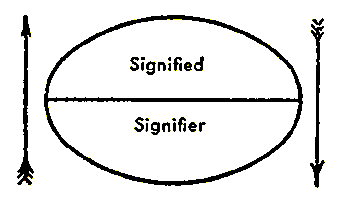
[1] To be clear, the conception that Saussure was "struggling against" is that sign unites a thing and a name. Saussure is quite explicit that a linguistic sign is a psychological entity with two levels of abstraction: concept and sound-image. Saussure (1959: 66):
The linguistic sign unites, not a thing and a name, but a concept and a sound-image. The latter is not the material sound, a purely physical thing, but the psychological imprint of the sound, the impression that it makes on our senses. The sound-image is sensory, and if I happen to call it "material," it is only in that sense, and by way of opposing it to the other term of the association, the concept, which is generally more abstract.The psychological character of our sound-images becomes apparent when we observe our own speech. Without moving our lips or tongue, we can talk to ourselves or recite mentally a selection of verse. …The linguistic sign is then a two-sided psychological entity that can be represented by the drawing:The two elements are intimately united, and each recalls the other.
Ambiguity would disappear if the three notions involved here were designated by three names, each suggesting and opposing the others. I propose to retain the word sign [signe] to designate the whole and to replace concept and sound-image respectively by signified [signifié] and signifier [signifiant] ; the last two terms have the advantage of indicating the opposition that separates them from each other and from the whole of which they are parts.
The word symbol has been used to designate the linguistic sign, or more specifically, what is here called the signifier. Principle I [the arbitrary nature of the sign] in particular weighs against the use of this term. One characteristic of the symbol is that it is never wholly arbitrary; it is not empty, for there is the rudiment of a natural bond between the signifier and the signified. The symbol of justice, a pair of scales, could not be replaced by just any other symbol, such as a chariot.